
The Speech Problem
How modern yoga talks and what that talk quietly changes

If you spend any time around modern yoga, you start hearing the same explanations repeated across studios, trainings, and social media. They’re usually well-meaning. They often sound generous, soothing, and accessible. Over time, they also become definitional, which is where the trouble begins. Yoga doesn’t only change through products and pricing; it changes through the everyday sentences that tell new practitioners what yoga is, what yoga is for, and what parts of it are optional.
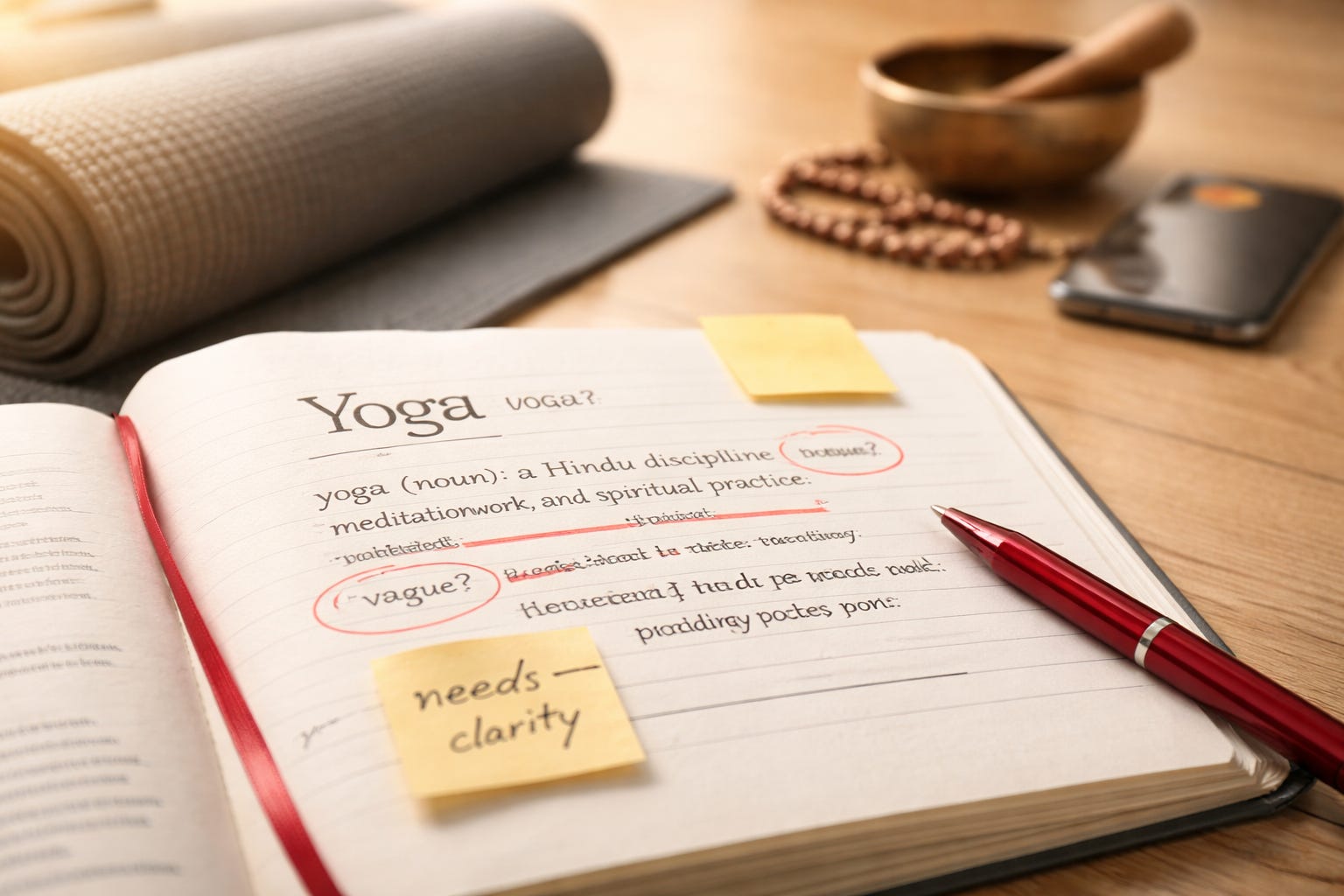
You’ll hear some version of: “Yoga is whatever you need it to be.” Or “Yoga is basically movement and breath.” Or “Yoga is spirituality, not religion.” Or “Yoga is healing.” None of these lines are necessarily said with malice. Many people repeat them out of a sincere desire to help, to include, and to soften the sharp edges that sometimes show up in spiritual spaces. The issue is that traditions are not preserved by sincerity alone. They are preserved by disciplined transmission, and disciplined transmission begins with disciplined language.
Yoga is being transmitted in sentences now, and that changes what counts as yoga.
The sentences modern yoga repeats
The most effective distortions are rarely hostile, and that is why they work. They arrive as simplification that sounds like kindness. They arrive as “making it accessible.” Over time, the simplification becomes the framework, and the framework starts dictating what yoga is allowed to mean.
This is also why the conversation gets emotionally charged so quickly. People aren’t merely defending a definition; they’re defending an experience that helped them. But yoga, as a tradition, can’t be held together by experience alone. Experience is real, and experience matters, but it doesn’t automatically create accurate understanding. It certainly doesn’t automatically grant authority to redefine terms that have carried meaning for centuries.
When one word is asked to hold everything
In modern usage, “yoga” is being asked to cover fitness, mobility, breathwork, stress relief, community, identity, therapy, nervous system regulation, and a general sense of self-improvement. Some of those experiences may be real and beneficial. I’m not dismissing that. What I’m pointing to is what happens when we pretend they are interchangeable and then keep using one word to cover the whole bundle.
When a word becomes broad enough, it becomes vague enough. And when it becomes vague enough, it becomes ownerless. Ownerless language is easy to repackage, because there is no accountable meaning to protect. You can attach the word to almost anything and still sound legitimate. That might feel expansive in the short term, but over time it erodes the ability to say what yoga is and what it is not.
When a word can mean almost anything, it becomes easy to repackage and hard to protect.
Why good intentions don’t preserve meaning
I want to be explicit about what I’m not doing here, because it matters. I live in America. I’m a citizen. I’m not interested in turning this into a geography argument where one place is morally superior and another is morally corrupt. Modern life everywhere rewards speed, confidence, and simplicity. Yoga, as it travels, absorbs those incentives.
The question is whether we are willing to admit what gets lost under the pressure to simplify. In serious domains like medicine, engineering, law, we understand that language is not decoration. Precision is not elitism; precision is how you prevent harm. Yoga is one of the few spaces where we’ve been trained to treat precision as aggression and vagueness as compassion. That’s a cultural habit worth questioning, because vagueness can feel gentle while still quietly distorting a tradition.
A tradition-level view of speech
In the Indian imagination, there is a name for the discipline of clean speech and responsible transmission: Saraswati. You do not have to be Hindu to grasp the idea, and you certainly don’t have to treat it as “mythology” in order to see what it points to. Think of this concept as a reminder that speech is power, and anything powerful requires standards.
Saraswati is often flattened into “the goddess of knowledge,” and in modern wellness spaces she becomes a soft symbol for creativity or flow. That framing is emotionally easy, but it misses what the tradition is actually guarding. The older emphasis is on speech on the way language shapes minds, ethics, relationships, and reality itself. Knowledge sitting inside books can’t do much harm. The harm begins when knowledge travels through mouths with the arrogance of certainty, or the carelessness of half-study, or the seduction of performance.
This is why disciplined traditions do not treat interpretation as a free-for-all. Indian philosophical traditions have always allowed debate, but they also insist on a question modern culture increasingly avoids because it slows down certainty: how do you know what you claim to know? The classical word is pramāṇa, valid means of knowing. In plain English, it forces intellectual honesty about your source, your method, and your scope. It interrupts the modern habit of speaking first and studying later.
Readiness isn’t elitism
Another concept that gets misunderstood because people hear it through modern suspicion is adhikāra, readiness or fitness. It is easy to caricature this as exclusion or “gatekeeping,” but the logic is ordinary and universal. We accept readiness everywhere else. Nobody wants an engineer signing off a design based on enthusiasm. Nobody wants a therapist improvising a modality because it “resonates.” Nobody wants a surgeon learning on the patient.
Readiness is not oppression. Readiness is responsibility.
Applied to yoga, it doesn’t mean only scholars can speak or only certain identities can belong. It means that the right to teach, interpret publicly, or redefine terms isn’t granted by confidence or audience size. It is earned through study, practice, guidance, humility, and time. Without that, yoga becomes a culture where persuasion replaces understanding, charisma replaces competence, and tradition becomes an aesthetic that can be rearranged freely.
The quiet role of tuning
If you prefer to keep Saraswati entirely out of deity language, you can still hold the central lesson: speech must be tuned. A person can be intelligent, articulate, and well-intentioned and still be “untuned” in ways modern culture rewards, the hunger to be seen, the need to be right, the habit of speaking in absolutes, the tendency to moralize, the desire to compress nuance into a headline.
Even correct statements can become harmful when they are delivered through ego, haste, or performance. That’s why truth alone is not the standard. Integrity is. The deeper question is not only “Is this true?” but also “Am I fit to carry this truth without distorting it in my voice?”
A cultural reminder I still keep
Even now, living a modern American life, I keep one small version of a practice I saw growing up. Once a year, around the time spring begins to show itself, many Hindu families mark a day connected with learning books, music, study, speech, discernment (a festival to worship Ma Saraswati). The rituals differ, but the underlying posture is the same: clean the space, handle what you learn with respect, and don’t treat speech as casual.
You don’t have to share my culture to understand why this matters. When language is cheap, people become careless with truth, and traditions become easy to remodel without noticing. A yearly reminder to slow down around knowledge to treat it as something that can clarify or injure, feels less like “religion” to me and more like a sanity practice.
A speech discipline worth borrowing
If you teach yoga, write about yoga, or even just speak about it in your circles, you don’t need a festival to practice the core principle. You can treat speech as part of the practice.
Before making a strong claim, it helps to ask: am I within my real scope? Do I know my sources, or am I repeating what’s popular? Am I using loaded words carefully, or casually? Will what I am saying reduce confusion, or will it create heat while sounding virtuous? This isn’t censorship. It’s restraint, and restraint is a yogic value. It is also, in my view, the only way yoga survives as something more than a flexible wellness label not by better branding, and not by louder arguments, but by seriousness, shown through study, practice, and language that respects definitions enough to keep the tradition intact.
I’m still learning how to hold my own speech to a higher standard, in times where quick takes are rewarded. This is one place where yoga has changed me in real life: not in what I can do with my body, but in what I’m willing to say, and what I’m willing to leave unsaid until I’ve studied more. As someone living in America, I care about making yogic teachings and deeper connection to Sanatan Dharma accessible without making it vague. The balance is hard, and I am still working it out in my own life. Writing is one way I practice that discipline publicly.
If you want more essays like this, rooted, honest and unwilling to turn scared stories to slogans, subscribe and stay connected. And if you disagree, I am open to thoughtful dialogue.
May our speech be more careful than our opinions, and more true than our confidence.
A beautiful lesson, Trupti! The Hindu lessons in listening, silence, and using 'right speech' have changed my life. I hope this lesson changes other people's too. Thank you for a reminder of this teaching.
I loved this. Thank you for sharing this, it has given me so much to reflect over! I am inspired to be more intentional about my communication, the parts that are verbal, written, and silent.